Mark Twain and the Mormons

It has been a while since I posted anything on this blog, and many things have happened since my last post. Sadly, many of those things will have to be left without comment – the moment has simply passed. But, in order to get back into writing, I thought I would start with a simple, and lighthearted post, and one which I have been wanting to write for some time.

Mark Twain in 1867

In 1872 Samuel Longhorn Clemens, (Mark Twain) published an autobiographical account of his travels thru the Wild West during the span of years from 1861-1867. It was during these travels in the pioneer west, that he first made use of the pen name, “Mark Twain”. While on these travels Samuel learned many things; among them was “how far he could push a joke” a lesson learned from some “disagreeable experiences” he brought upon himself.

He made these travels with his older brother, Orion Clemens, who was the newly appointed Secretary of the Nevada Territory (its first and only). In writing the account, Twain relied on his brother’s diary to refresh his memory. In order to fill in the gaps, he borrowed heavily from his own active imagination, and wry sense of humor.

Altho I would recommend the book generally, it is very long, being 608 pages. And tho I have read a good deal of it, I could not push myself to complete it before the library stopped allowing my renewals.

However, for the interest and entertainment of the reader, I will reproduce some briefer quotations from the book below. The Great Salt Lake City, founded by Mormons in 1847, became known as, “The Crossroads of the West”. A great many travelers, famous, infamous, and otherwise, came thru Salt Lake City in those early pioneer days. Many of them were naturally curious to see the Mormons and their peculiar ways; namely, plural marriage. Samuel Clemens was no exception, and goes on for several chapters of his book, Roughing It, describing his experiences in Utah among the Mormons.

In the beginning of Chapter 13, after arriving in Great Salt Lake City (more commonly known today by its short form, “Salt Lake City”, or even just, “Salt Lake”), Twain reports:

We had a fine supper, of the freshest meats and fowls and vegetables—a great variety and as great abundance. We walked about the streets some, afterward, and glanced in at shops and stores; and there was fascination in surreptitiously staring at every creature we took to be a Mormon. This was fairy-land to us, to all intents and purposes—a land of enchantment, and goblins, and awful mystery. We felt a curiosity to ask every child how many mothers it had, and if it could tell them apart; and we experienced a thrill every time a dwelling-house door opened and shut as we passed, disclosing a glimpse of human heads and backs and shoulders—for we so longed to have a good satisfying look at a Mormon family in all its comprehensive ampleness, disposed in the customary concentric rings of its home circle.

He goes on to say:

Next day we strolled about everywhere through the broad, straight, level streets, and enjoyed the pleasant strangeness of a city of fifteen thousand inhabitants with no loafers perceptible in it; and no visible drunkards or noisy people; a limpid stream rippling and dancing through every street in place of a filthy gutter; block after block of trim dwellings, built of “frame” and sunburned brick—a great thriving orchard and garden behind every one of them, apparently—branches from the street stream winding and sparkling among the garden beds and fruit trees—and a grand general air of neatness, repair, thrift and comfort, around and about and over the whole. And everywhere were workshops, factories, and all manner of industries; and intent faces and busy hands were to be seen wherever one looked; and in one’s ears was the ceaseless clink of

One Crest

hammers, the buzz of trade and the contented hum of drums and fly-wheels.

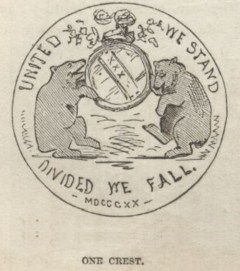
The armorial crest of my own State consisted of two dissolute bears holding up the head of a dead and gone cask between them and making the pertinent remark, “UNITED, WE STAND—(hic!)—DIVIDED, WE FALL.” It was always too figurative for the author of this book. But the Mormon crest was easy.

The Other

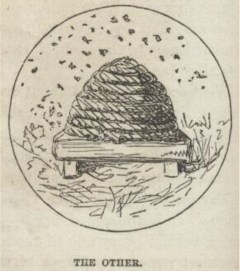
And it was simple, unostentatious, and fitted like a glove. It was a representation of a GOLDEN BEEHIVE, with the bees all at work!

We saw the “Tithing-House,” and the “Lion House,” and I do not know or remember how many more church and government buildings of various kinds and curious names. We flitted hither and thither and enjoyed every hour, and picked up a great deal of useful information and entertaining nonsense, and went to bed at night satisfied.
On the next day Twain was very much excited to meet the famous, Brigham Young, but the feeling was not as mutual as he would have liked.

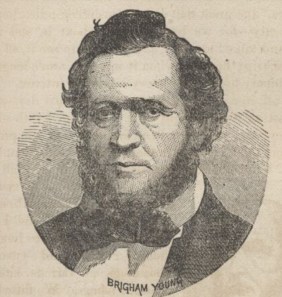
The second day, we made the acquaintance of Mr. Street (since deceased) and put on white shirts and went and paid a state visit to the king. He seemed a quiet, kindly, easy-mannered, dignified, self-possessed old gentleman of fifty-five or sixty, and had a gentle craft in

Brigham Young

his eye that probably belonged there. He was very simply dressed and was just taking off a straw hat as we entered. He talked about Utah, and the Indians, and Nevada, and general American matters and questions, with our secretary and certain government officials who came with us. But he never paid any attention to me, notwithstanding I made several attempts to “draw him out” on federal politics and his high handed attitude toward Congress. I thought some of the things I said were rather fine. But he merely looked around at me, at distant intervals, something as I have seen a benignant old cat look around to see which kitten was meddling with her tail.

By and by I subsided into an indignant silence, and so sat until the end, hot and flushed, and execrating him in my heart for an ignorant savage. But he was calm. His conversation with those gentlemen flowed on as sweetly and peacefully and musically as any summer brook. When the audience was ended and we were retiring from the presence, he put his hand on my head, beamed down on me in an admiring way and said to my brother:

“Ah—your child, I presume? Boy, or girl?”
As for Twain’s intentions to bring about a reformation of the Mormons, on the subject of polygamy, he had these sobering words to share in Chapter 14:

Our stay in Salt Lake City amounted to only two days, and therefore we had no time to make the customary inquisition into the workings of polygamy and get up the usual statistics and deductions preparatory to calling the attention of the nation at large once more to the matter.

I Was Touched

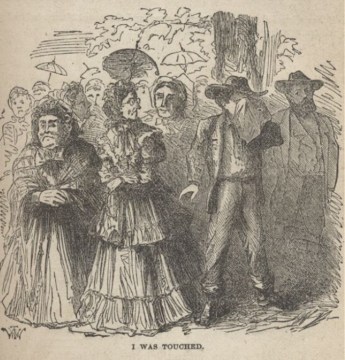
I had the will to do it. With the gushing self-sufficiency of youth I was feverish to plunge in headlong and achieve a great reform here—until I saw the Mormon women. Then I was touched. My heart was wiser than my head. It warmed toward these poor, ungainly and pathetically “homely” creatures, and as I turned to hide the generous moisture in my eyes, I said, “No—the man that marries one of them has done an act of Christian charity which entitles him to the kindly applause of mankind, not their harsh censure—and the man that marries sixty of them has done a deed of open-handed generosity so sublime that the nations should stand uncovered in his presence and worship in silence.”
And finally in Chapter 15, he shares a humorous tale which, tho fictitious, has a kernel of truth. It was supposedly told to Mark Twain by a Gentile named Johnson:

Mr. Johnson said that while he and Mr. Young were pleasantly conversing in private, one of the Mrs. Youngs came in and demanded a breast-pin, remarking that she had found out that he had been giving a breast-pin to No. 6, and she, for one, did not propose to let this partiality go on without making a satisfactory amount of trouble about it. Mr. Young reminded her that there was a stranger present. Mrs. Young said that if the state of things inside the house was not agreeable to the stranger, he could find room outside. Mr. Young promised the breast-pin, and she went away. But in a minute or two another Mrs. Young came in and demanded a breast-pin. Mr. Young began a remonstrance, but Mrs. Young cut him short. She said No. 6 had got one, and No. 11 was promised one, and it was “no use for him to try to impose on her—she hoped she knew her rights.” He gave his promise, and she went. And presently three Mrs. Youngs entered in a body and opened on their husband a tempest of tears, abuse, and entreaty. They had heard all about No. 6, No. 11, and No. 14. Three more breast-pins were promised. They were hardly gone when nine more Mrs. Youngs filed into the presence, and a new tempest burst forth and raged round about the prophet and his guest. Nine breast-pins were promised, and the weird sisters filed out again. And in came eleven more, weeping and wailing and gnashing their teeth. Eleven promised breast-pins purchased peace once more.

“That is a specimen,” said Mr. Young. “You see how it is. You see what a life I lead. A man can’t be wise all the time. In a heedless moment I gave my darling No. 6—excuse my calling her thus, as her other name has escaped me for the moment—a breast-pin. It was only worth twenty-five dollars—that is, apparently that was its whole cost—but its ultimate cost was inevitably bound to be a good deal more. You yourself have seen it climb up to six hundred and fifty dollars—and alas, even that is not the end! For I have wives all over this Territory of Utah. I have dozens of wives whose numbers, even, I do not know without looking in the family Bible. They are scattered far and wide among the mountains and valleys of my realm. And mark you, every solitary one of them will hear of this wretched breast pin, and every last one of them will have one or die. No. 6’s breast pin will cost me twenty-five hundred dollars before I see the end of it. And these creatures will compare these pins together, and if one is a shade finer than the rest, they will all be thrown on my hands, and I will have to order a new lot to keep peace in the family.

Sir, you probably did not know it, but all the time you were present with my children your every movement was watched by vigilant servitors of mine. If you had offered to give a child a dime, or a stick of candy, or any trifle of the kind, you would have been snatched out of the house instantly, provided it could be done before your gift left your hand. Otherwise it would be absolutely necessary for you to make an exactly similar gift to all my children—and knowing by experience the importance of the thing, I would have stood by and seen to it myself that you did it, and did it thoroughly. Once a gentleman gave one of my children a tin whistle—a veritable invention of Satan, sir, and one which I have an unspeakable horror of, and so would you if you had eighty or ninety children in your house. But the deed was done—the man escaped. I knew what the result was going to be, and I thirsted for vengeance. I ordered out a flock of Destroying Angels, and they hunted the man far into the fastnesses of the Nevada mountains. But they never caught him. I am not cruel, sir—I am not vindictive except when sorely outraged—but if I had caught him, sir, so help me Joseph Smith, I would have locked him into the nursery till the brats whistled him to death. By the slaughtered body of St. Parley Pratt (whom God assail!) there was never anything on this earth like it! I knew who gave the whistle to the child, but I could, not make those jealous mothers believe me. They believed I did it, and the result was just what any man of reflection could have foreseen: I had to order a hundred and ten whistles—I think we had a hundred and ten children in the house then, but some of them are off at college now—I had to order a hundred and ten of those shrieking things, and I wish I may never speak another word if we didn’t have to talk on our fingers entirely, from that time forth until the children got tired of the whistles. And if ever another man gives a whistle to a child of mine and I get my hands on him, I will hang him higher than Haman! That is the word with the bark on it! Shade of Nephi! You don’t know anything about married life. I am rich, and everybody knows it. I am benevolent, and everybody takes advantage of it.

I hope you all enjoyed these accounts, and can see the humor in them.

Happy Pioneer Day!

Family Is Always First

I want to write about a serious deficiency that many families face.  It is a plague upon the modern family: absentee fathers.  Sadly, much of the blame for this plague can be placed at the feet of our own government.  For generations now they have incentivized (in other words, encouraged) fatherless homes, and encouraged our women to marry the government. Fatherless homes are perhaps the biggest problem facing our culture.

The percentage of children born out of wedlock has increased dramatically in this country over the past few decades.  A generation or two ago only 5% of births were to unmarried women.  The current figure is hovering somewhere around 40%!  One of the amazing things about this trend is that it has happened after the invention of modern birth control! Shouldn’t the availability of birth control methods have lowered the incidence of births out of wedlock?  It seems that it has had the opposite effect in some regards. It has simply helped to create a culture of ever deteriorating morals. It doesn’t take a psychologist or social scientist to realize that this trend is detrimental to our society in a great many ways.

75_Births-to-Unmarried-Women_Image1

Children do better in every way with both a father and a mother in the home!  And fathers especially seem to have a large positive influence.  Children do better in every way you could think to measure when there is an involved father in the home.  There is a large body of evidence supporting what we already instinctively know about fathers, but in a time such as ours, when truth and wisdom are so often seen as foolishness (or “backwards” or “outdated” or “sexist” etc.), it is good to have some facts at our disposal.

Here I have gathered some statistics from various sources.  Please don’t write any comments about exceptions to these statistics.  I know there are bad fathers and husbands out there.  Maybe even your very own father was abusive.  If so, I would be very sorry to hear it, but it in no way contradicts the numbers I am about to share.  These numbers are speaking about fathers in general, and, generally speaking, fathers are very good to have around.

85% of all children who show behavior disorders come from fatherless homes.

71% of high school dropouts come from fatherless homes.

71% of pregnant teens have no father present in their life. Fatherless children are more likely to have children outside marriage or outside any partnership whatsoever.

90% of runaway children have an absent father.

Fatherless children are more likely to smoke, drink alcohol, and abuse drugs in childhood and adulthood.

nationalfatherhoodinitiativefatherabsencecrisis

Fathers are the natural protectors of their families. Therefore, fatherless children are at greater risk of suffering physical, emotional, and sexual abuse.    Preschoolers living only with their mother are 40 times more likely to be sexually abused, and 5 times more likely to experience physical abuse and emotional maltreatment (with a 100 times higher risk of that abuse being fatal).

Fatherless children report significantly more psychosomatic health symptoms and illness such as acute and chronic pain, asthma, headaches, and stomach aches.

Children with absent fathers are consistently overrepresented among those with anxiety, depression, and suicidal tendencies.

As adults, fatherless children are more likely to experience unemployment, have low incomes, remain on social assistance, and experience homelessness.

Children with absent fathers are more likely to divorce, or dissolve their cohabiting unions.

Fatherless children are more likely to die as children, and live an average of four years less over the life span.

Given the fact that these and other social problems correlate more strongly with fatherlessness than with any other factor, surpassing race, social class, and poverty, father absence may well be the most critical social issue of our time.

Fathers are an absolutely vital part of human life and development, but a part that is often discredited and marginalized.  Our society at large is screaming at men and boys that they ought to be ashamed for what they have done (i.e. existing as males), and for the negative effects they have had on the world.  And that they ought to apologize for some imagined and unearned “privilege” which they have stolen from women – whom they have horribly abused and oppressed for the whole of history, and continue to oppress to the present day.  Our children are constantly being fed the lie that men ought to be more like women, and that women and men are equal in every way.  It is all a part of the attempted suicide of our western culture, and there are real and concerted efforts on many fronts to achieve this end.

For example, the American Psychological Association (APA) recently released their Guidelines for Psychological Practice with Boys and Men wherein they state, “Research suggests that socialization practices that teach boys from an early age to be self-reliant, strong, and to minimize and manage their problems on their own yield adult men who are less willing to seek mental health treatment.”  The entire premise of this sentence is one of the most ridiculous things I have ever seen in print.  Conflict of interest much?  In other words these psychologists are saying, “Teaching boys to be strong, self reliant, and to manage their own problems, makes them not give as much money to us when they are adults.”  Just think of it, they are criticizing teaching boys to be self-reliant, strong, and to manage their own problems!  These people are actively engaged in the destruction of everything good and right in the world.

Here is what Jordan Peterson had to say about the document mentioned:

Let me translate this opening salvo into something approximating clear and blunt English. The authors are claiming that men who socialize their boys in a traditional manner destroy their mental health. This translation/clarification needs to be extended to the second major claim of the document, which is distributed more subtly through its body. We’ll begin with this quote, taken from the Guidelines (p. 3): “Research suggests that socialization practices that teach boys from an early age to be self-reliant, strong, and to minimize and manage their problems on their own yield adult men who are less willing to seek mental health treatment,” in combination with this one (p. 3, as well): “Men are overrepresented in prisons, are more likely than women to commit violent crimes, and are at greatest risk of being a victim of violent crime (e.g., homicide, aggravated assault; Federal Bureau of Investigation, 2015).” So, it’s not only that men who encourage their boys to be “self-reliant, strong and manage their problems on their own” destroy the mental health of their children: they also produce adults who are a primary menace to their families and society.

This is all bad enough (and by that I mean inexcusable) conceptually, rhetorically and politically. But it’s also a lie, scientifically—and worse (because not merely a lie; instead, something more unforgivable). To indicate, as the writers have, that it is the socialization of boys and men by men that is producing both a decrement in the personal mental health of males and females and a threat to the social fabric is not only to get the facts wrong, but to get them wrong in a manner that is directly antithetical to the truth…

It’s simple – and it is this simple fact that is absolutely damning to the claims in the APA document. What kind of families produce violent young men? Fatherless families. The pernicious effect of fatherlessness is exceptionally well-documented. No serious researchers question it. Even the generally damnable sociologists admit it (see, for example, http://bit.ly/2HB27JL). Fatherless girls tend, for example, toward early sexual experimentation (something in itself linked to antisocial behavior) and, unsurprisingly, higher rates of teenage pregnancy. What might be more surprising, however, is that there is even evidence for earlier puberty among girls whose fathers are absent. Fatherless boys are over-represented as alcoholics, addicts, gang-members, prisoners, rapists and murderers. And there’s plenty of what is positive that is lacking among fatherless children, in addition to the negative that is more likely to be present (here’s a decent summary, in lay language: http://bit.ly/2HB27JL)

Consider this (it’s of primary importance): If it is fatherless boys who are violent, how can it be that masculine socialization produces harm both to mental health and society? The data should indicate precisely the opposite: that boys who are only raised by women are much less violent than boys who have men in their lives and, similarly, that boys who do have fathers are more violent than those who do not.

This is not the case. Period.

What does all of this have to do with polygamy?  A lot.  Diminished influence of a strong father figure is obviously a potential problem facing polygamous families as well – especially if the wives live in separate houses (and more especially if those houses are separated by great distances).  And of course, the danger of this increases with each additional wife in a family (assuming the branches of the family live separately).  Having the father absent every other evening, or whatever, is potentially going to have a negative effect on his children, and that is a problem that plural husbands need to address!

A few episodes ago Vanessa Cobbs has her two sisters visit in L.A. and there are some tense moments between them – especially between her and her twin sister Adrienne.  At one point Adrienne tells Vanessa that she will never be the center of Dimitri’s world.  I Vanessa’s reply: that Dimitri’s universe is big, that she and Ashley are both the center of it, and that his children are at the center of it too!

so are his children

In the next episode we see Adrienne talking to Ashley and Dimitri around the pool.  She’s still not convinced, but she is showing some openness to the idea, and wants to actually know more about it.  At one point she is talking to Dimitri and I ❤ this exchange as well!  It so completely shows the outlook that a successful plural husband must have.

hobby

She asks him about the difficulties of providing for the emotions and well being of two women.  In reply he speaks of listening and giving each woman what she needs.  She then asks him about time, and his response is that he, “builds around his family”, “keeps them in the center”, and makes his “family always first”.  In this way he can allocate his time and resources to meet his family’s needs.  From what we are seeing, Dimitri seems to be doing it well.  I love too that she eventually came around, and even apologized to Vanessa for her earlier offensiveness.

family first

Men need to be there. They need to make their families a priority. There is no substitute for a father in the home, and polygamous men, if they want to have a successful family, need to work extra hard to make it happen. They need to be thinking of their families all the time, and acting in a way that puts them first.  Polygamous men don’t have time for hobbies – their families need to be their hobby, or they need to find a way to involve their family in their hobbies.  Seriously; if you are a video gamer, you probably shouldn’t be a polygamist.  If you spend all your evenings watching sports with the guys, you probably shouldn’t be a polygamist.  If you spend every free weekend at the golf course, you probably shouldn’t be a polygamist.

I am not speaking against recreation. I am speaking about priorities and life-habits. By all means, read a book, take a walk, watch the big game. All that is a needful part of a healthy life, but these things will necessarily occur much less frequently for plural men.  At least, they will occur less frequently without your family present.

The difference is that polygamous men might read a book – to their children, take a walk – with their wives, and watch the big game with their sons – rather than with the guys.  I am not saying that monogamous men don’t do these things; I am saying that polygamous men must.

There are amazing plural families and amazing monogamous families. Of course, both can be dysfunctional as well. In either case the difference, I believe, is largely a difference in dedication.

No matter your position in life, or the type of family structure you are a part of, let’s raise healthy, strong, confident, self-sufficient children – and unapologetically so.  Let’s push back against the cultural suicide that is occurring. Let’s make this country and this world a better place!