
One objection, commonly raised against polygamy as a viable family structure, is the birth ratio of females to males. Here is an example that was sent to me by a reader of this blog:
“Under normal circumstances, slightly more men are born that women, unfortunately the men die sooner, even in the first year. By their twenties, the number of men is roughly equal to that of women, so for one man to take more than one wife means that other men must go without.”
There is a lot to unpack in order to answer this objection, and nuances that we will miss if we paint with too broad a brush. While this objection does contain a kernel of truth, it also carries with it some false assumptions. It is my contention that this objection is lacking so much in the way of factual details, that it becomes untrue – it is a false objection.
It is true that there are born more male babies than female. The ratio of female to male births in the US is about 0.95 (that is, 1 female per every 1.048 males). It is also true that males die off more rapidly than females for a variety of reasons. In fact, the death rate for males is higher than for females at every age. It is true that there are approximately equal numbers of men and women of marrying age; however, there are still more men than women till about age 45 or so, where there begins to be more women than men. When looking at the population as a whole the ratio of females to males is about 1.02 (that is 1 female per every 0.98 males, or an excess of more than 3.3 million females given the current US population). This excess of females on the whole is due to the differential in death rates between men and women.
These are the facts; however, there are several assumptions that make these facts insufficient as an argument against polygamy (and also insufficient as an argument for polygamy). First, these statistics only say something about the total number of males, but not about the number of males that are suitable for marriage partners (i.e. that would make good husbands and fathers). Taking this into account will shift the ratio of marriageable women to men to some number greater than 1. I believe this is instinctively true from common experience as well as from various social statistics. The reason for this has to do with the fact that there exists greater male variability (compared to women).
When comparing males to other males, there are greater differences of all sorts: physical, psychological, and genetic than when comparing females to other females. In other words, men tend to have a greater variety and expression of traits than women. Women are more similar to each other than men are similar to each other. This phenomenon is exhibited across many different species, including humans, and plays a large role in mate selection.
Humans are dimorphic, but even if we measure traits that are not affected (or only minimally affected) by our dimorphism we will see a difference between male and female populations. In these cases, the difference will manifest in the variance of the population, rather than the averages. The graph below does not correspond with any particular data set but is for the purpose of illustrating this principle.
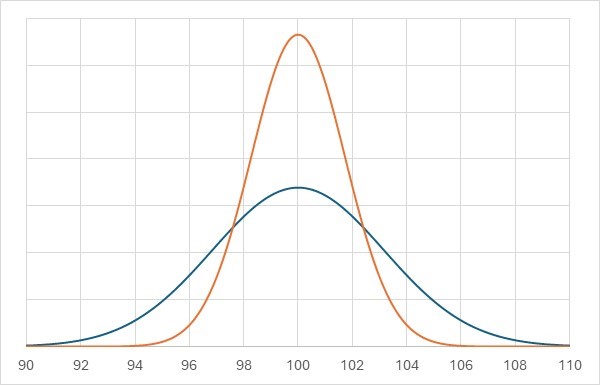
Suppose this represents the distribution of some “measured competence” for a particular population of people. The data has been separated into sub-populations of men and women. The red curve represents the female distribution, while the blue is for the males. The curves represent the same number of individuals for both sexes (i.e. the curves have the same area under them). Looking at these curves we can truthfully say that these populations of men and women have the same competence scores (with a mean = 100). However, it should also be obvious that there is greater variance, or variability, in the men’s scores. Women tend to cluster around average (they are more average, or rather, there are more average females) while there are more men at both ends of the bell-curve (i.e. the “tails” of the distribution are fatter).
This type of statistical difference between the sexes has manifest itself in many measurable traits. We can look at IQ as one example (here and here for example). There are more men who are geniuses than women (think of famous or well-accomplished scientists, composers, mathematicians, chemists, doctors, etc.). HOWEVER, there are ALSO more men who are idiots and otherwise incompetent than women (this is part of the reason men have higher death rates compared to women, haha).
These types of differences (differences in variability of traits between men and women – with greater variabilities in men) can be seen across many different traits including intelligence, personality, risk taking, brain structure, height and weight, strength, speed, blood chemistry (triglyceride and cholesterol levels), aggression, honesty, cooperation, and many others.
Some of this variability (such as blood chemistry) will have relatively little to do with a man’s suitability as a husband and father (i.e. his ability to form lasting, stable, and fulfilling relationships with both spouse and offspring and provide a safe and sustainable living), but much of this variability will greatly affect those things. Each individual trait is only a small part of a person or population. If taken alone, a significant deficiency in a single trait could be enough to effectively disqualify some individuals from being a marriage candidate (or prevent their marriages from succeeding once entered into). However, taken in total, the sum of these deficiencies will have a very large effect on mate selection and family structures spanning all of human history. This is borne out when we examine human reproductive success overall where we see clear evidence of greater male variability. Men, as a whole, are less successful at passing on their genetics in comparison to women. Obviously, every child always has both mother and father, so you might argue that men and women must be equally successful at reproducing, but this is only when looking at the average. You also have to look at the spread of the data. More women will have children than men will. There are more men than women with 0 children, but also more men than women who have 12 children. Again, women tend to be closer to the average, while men have more spread towards the extremes. Altho it may be surprising, this is why you have twice as many mothers as fathers (ancestrally speaking).
Cooperation is another interesting trait that is “identical” between the sexes. Quoting from a 2020 article in Forbes:
“Across the studies, the researchers found no difference in the degree to which men and women behaved cooperatively in the games. In other words, the average donation made by a participant to support another partner or to promote the collective good in a game did not depend on one’s gender.
However, the researchers noticed a fascinating trend: men were much more likely to contribute very little, or very much, in the context of a game. For example, men were more likely to fall into the category of game “free riders,” or those who maximize their own benefit by minimizing their contribution to the “greater good.” They were also more likely to fall into the category of “unconditional helpers,” or those who elected to help others at their own expense, even when such help wasn’t reciprocated by others.
Women, on the other hand, were more likely to offer partial support, or to “conditionally cooperate,” in the social dilemma experiments they analyzed.
“By focusing on variability of behaviors rather than central tendencies, we were able to provide evidence for strong and systematic sex differences in the distribution of cooperation behaviors,” say the researchers. “This finding is important given that cooperation is not the only area in which the prevailing focus on central tendency may have masked important sex differences in the tails of the distribution.”
There are more men than women who are scientists, engineers, mathematicians, and inventors. More men than women who are adventurers, explorers, athletes, highly motivated, and highly competent. There are more men than women who are pastors & preachers, CEOs, entrepreneurs, millionaires & philanthropists, etc. However, do not be mistaken in thinking that I am saying men are “better” than women. Men are different. Men are not “better” because there are also more men than women who are criminals, idiots, fools, homosexuals, insane, drug addicts and alcoholics, homeless, cowards, atheists, weaklings, lazy bums, irreligious, etc. In other words, there are more men at BOTH ends of the bell curve.
Looking at religiosity, which is an important factor in mate selection for many women (and certainly among many Mormon women), in the LDS Church there is a growing imbalance in the ratio of women to men (this trend is more broadly manifest in other Christian denominations as well, but the LDS Church is of particular interest to me). In the LDS Church there are currently, “three women for every two men” (or 1.5 women per man).
The sex ratio is especially lopsided among Mormon singles. Many individual LDS churches—known as “wards”—are organized by marital status, with families attending different Sunday services from single people. Parley’s Seventh, one of Salt Lake City’s singles wards [as an example], had 429 women on its rolls in 2013 versus only 264 men (more than 1.6 women per man). My friend Taylor has an excellent blog post on this subject.
We could take many of these traits and assign some sort of “cut-off” value; a value below which a person becomes unmarriageable. This cut-off value is somewhat subjective, and will vary from person to person, but we can all imagine the existence of such a line. If we go back to our measured competence example, assign an arbitrary cut-off value of 94 (again, this is only for the purpose of demonstration), and say that anyone below this competency will not likely be fit to marry, then we should immediately be able to see that this will affect more men than women – i.e. the area under the curve, to the left of the cut-off, is greater for males than for females.

Every marriageable person (male or female) will be above some minimum acceptable score for intelligence, cooperation, personality traits, and various other measures of competence. This cut-off value, regardless of the trait, will disqualify more men than women. Because of these facts, looking merely at raw numbers of individuals is deceptive because: not everyone who COULD be married, SHOULD be married. This is true for both men and women, but more especially for men. My daughter Zoe also has an excellent post about this.
There are more men who are convicted felons than women. Of those, men outnumber women by about 10 times. Substance abuse is a large problem with more than 48 million Americans diagnosed with a substance abuse disorder every year. The rates of substance abuse among men is about double that for women. There are many more men who are homeless than women (more than double). Non-straight men outnumber women who are exclusively lesbian by more than 10 times. There are other measures we could list, and there is no doubt overlap between these sub-populations (e.g. some homeless people are also felons); however, taken together these factors paint a more accurate, and truthful, statistical picture to report.
I will not attempt to calculate the actual ratio of available “good” marriage candidates. It would be a difficult and subjective calculation anyway. Regardless, the combination of these many factors will flip the ratio of marriageable women to men to a number greater than 1.
Another false assumption embedded within this objection is that the ratio of raw numbers of men and women ought to dictate marital norms. If anything, this view would favor polyandry! Since men actually outnumber women for all normal marrying ages from 18 to 45. This is probably not the intended conclusion by those who raise this objection (since they are not actually arguing for “fairness”, but are merely opposed to Biblical marriage). Therefore, it is a misguided appeal to emotion to say that, if polygamy was practiced, some men would have to go without a wife. This already happens! Some men already go without wives and some women already go without husbands! Why is this so when the numbers are already so fair and even? Everyone knows that many men (and some women too) should not be married at all. Society does not “owe” every man a wife, just because there are roughly equal numbers of men and women. Furthermore, what an absolutely horrific policy that would be were it to be enforced in any way similar to the way polygamy suppression has been enforced!
Having said this, I openly acknowledge abuses that have occurred within some polygamous communities; abuses which have disenfranchised both single and married men. Warren Jeffs-style polygamy (marriages that are forced, assigned, controlled, dissolved, and rearranged by church leaders) is an absolute abomination, and a black eye on Mormonism. I believe only in marriage (monogamous or polygamous) between freely consenting adults. My family has taken the opportunity to house a young man who was a “refugee” from Colorado City. His experience was tragic, and his upbringing has put him at a severe disadvantage.
Another false assumption behind this argument is that we (or other polygamists) are asserting that polygamy should always be the rule for marriage. This is emphatically not the case. On the contrary, I assert that monogamy will always be, and should be, the most common form of marriage. However, it is unjust to limit marriage to monogamy, and doing so will prevent many women (who are eligible and desirous of marriage) to enter into matrimony. If the variability in the many traits discussed above, tips the ratio of marriageable females:males even 1% towards an excess of females (and it could easily be argued for a disparity far larger than this), then in the US alone (with a population of about 350 million) this would result an excess of several millions of eligible/suitable women!
If you believe that marriage is God-ordained (as I do), and that he desires this for as many of his children as possible (as I do), and simultaneously realize that the ratio of marriageable women to men is >1 (which is the case), then there will only be two ways to maximize the opportunities for “good” marriage partners. One is to allow for the possibility of plural marriage, which is scriptural and God-approved. The other (which is far more prevalent in our worldly, Babylonian society) is to practice serial-monogamy. That is, to spread out marriage partners thru successive divorces and remarriages. Some of my biggest critics are in this camp. Many of them have been married more than I have! They have just been divorced a few times as well!
The problem with espousing this second solution is that God himself hates divorce!
“For the Lord God of Israel says that He hates divorce, For it covers one’s garment with violence,” Says the Lord of hosts. “Therefore take heed to your spirit, That you do not deal treacherously.”
– Malachi 2:16 (NKJV)
Besides, if you needed more evidence to decide which of these two solutions God prefers, God describes himself as a polygamist. Take care lest you find yourself loving and accepting the things God hates, and dispising the things he loves and accepts.

 Speaking of Polygamy...